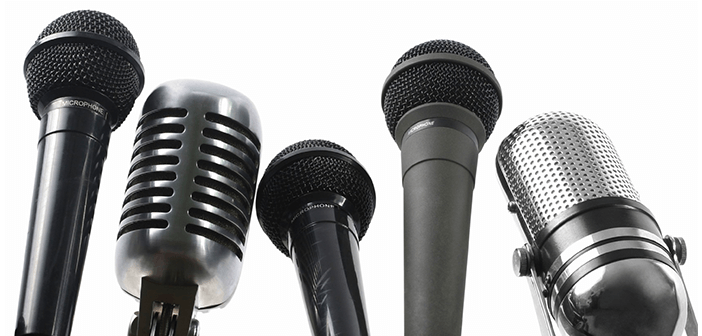
Let’s look at the best microphone for voice over work based on different budgets. In this review, we cover a range of voiceover microphones that are suitable for beginners, intermediates and advanced voiceover artists.
A List of Voiceover Equipment
The list below is just a quick guide to help you understand what you need to record properly. The reason for including this is to help you put together a budget that is right for you. This setup gives you a good basic start to recording your voice and producing demo-reels and auditioning.
If you are totally new to voice acting you need to determine first if you have a voice that is suitable for the voice acting industry.
- Voiceover Microphone: a microphone is required to capture the sound of your voice. The quality of your microphone will have a large impact on the overall quality of your recordings.
- Headphones: you need to be able to hear yourself without interfering with the microphone (bleed), so headphones are essential.
- Microphone Stand: having a mic stand improves your recordings by reducing movement and knocks so you get a better quality recording.
- Shock Mount: the shock mount suspends the microphone and helps reduce unwanted vibrations and rumbling.
- Pop filters: the pop filter reduces the plosive and sibilant sounds that the mouth makes (“P” sounds pop and “S” sounds hiss).
- An Audio Interface to connect your mic to your computer.
The Best Microphone For Voice Acting
The first thing to understand is the different types of microphones used in voice work.
- USB Microphones: this type of mic plugs directly into your computer’s USB port. It’s ideal for low-budget podcasting and entry-level voice-acting work.
- Dynamic Microphone: these are used for radio broadcasting, and live performances. They have a warm sound but do not have a high level of detail in the upper frequencies.
- Large Diaphragm Condenser Microphone: these mics are often used in studios to record voice sessions and have very detailed and lively sounding middle and upper frequencies.
What is Phantom Power?
Some mics need a little electrical power to work, in to convert the tiny signals picked up by the condenser into something usable by an audio interface or pre-amp. This electrical power is called “phantom power.” It’s a feature that’s commonly found on computer audio interfaces. Using phantom power isn’t complicated, and you shouldn’t be intimidated by it.
Why use a USB microphone?
USB microphone pros:
- A USB microphone connects to a computer through a standard USB port.
- You can record directly into a computer without the need for additional equipment.
- They’re relatively inexpensive.
USB microphone cons:
- Most USB mics are cheap, and the recording quality & fidelity is not great.
- Most USB microphones are dependent on a computer for operation, so they’re not as versatile as regular microphones.
- If your ultimate goal is to record the best-sounding voice-over possible, you’re going to need to use a different kind of microphone. Most USB mic’s that we’ve tested do not come up to par for professional voice recording.
What are the pros and cons of Dynamic Mics?
Dynamic Mic Pros:
- They are more forgiving when it comes to plosive sounds (the “P” sounds that pop and the “S” sounds that hiss), and thus are a little easier to work with, compared to Large Diaphragm Condenser mics.
- They don’t require phantom power to operate.
- They are very robust and great for live/stage use.
- They take an input of a huge dynamic range
Dynamic Broadcast Voice over Mic Cons:
- They often lack a little detail in the upper mids and high frequencies.
- They require additional equipment to use them with a computer.
- They do not capture the subtleties needed for voice recording
- Not recommended for studio voice recording
What are the pros and cons of Large Diaphragm Condenser Voice over Mics?
Large Diaphragm Condenser Pros:
- These mics have a very detailed response, as well as lively sounding upper frequencies.
- You can capture the highest quality of sound using one of these mics, especially the subtleties of the human voice.
- Recommended for Voice Recording
Large Diaphragm Condenser Cons:
- They will pick up on unwanted plosive and vibration noises due to their sensitivity, and may require a pop-shield
- Additional equipment is required to use them with a computer – your audio interface or pre-amp.
- They require phantom power to operate, although this isn’t really a con – but you need to ensure your audio interface will supply phantom power.
What are Polar Patterns?
Each microphone is different in its design and sound, but all follow a set of rules about how the actual sound is picked up by the microphone, and more crucially, where the sound is picked up. These rules are called the polar patterns of the microphone. There are:
- Omni-directional (picks up all the way around the mic)
- Bi-directional (picks up from the front and back of the mic – good for recording 2 people)
- Sub-cardioid (picks up all from the front and half from the back)
- Cardioid (essentially just picks up from the front)
- Hypercardioid and Supercardioid (pick up from the front and narrow ranges from the back)
- Shotgun (generally used for distance recording, have a very narrow, acute pickup point that is super-directional)
The most common (and really the only one a voice actor usually needs to be aware of) is cardioid.
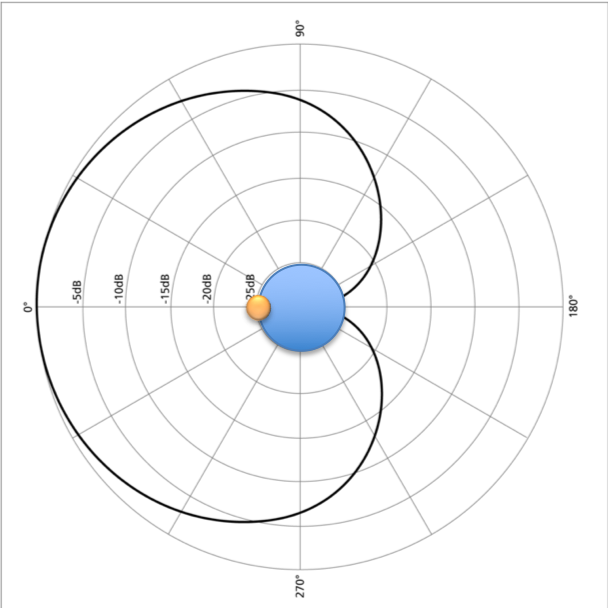
As you can see from the diagram (that’s a plan view looking at the top of the mic), the cardioid pattern only picks up from the front of the mic. Ideally, at 20′ off axis you will not get plosives but still pick up 100% of your dialogue. Some mics like the Neumann U87 have switchable polar patterns – you need to ensure that your mic has at least the cardioid pattern to be useful.
FREE EBOOK and MINI COURSE
Download Our FREE EBOOK on how to create your own voiceover business and take our FREE mini course. Start using your natural talent to earn money.What are Pads?
Pads are essentially switches which reduce the level of the input sound and ‘dampen’ the sound down. This is not relevant for voice artists and is only really useful for very loud inputs, such as miking up guitar amplifiers. Again, some mics have pad switches on, some do not.
The Difference Between Jack & XLR Connectors
All mics that require phantom power will be connected via XLR cable, which is a 3-pin cable. These cables provide the phantom power needed to make the mic work, but are also balanced. Using balanced cables (XLR cables) gives a better sound quality as it contains a system of eliminating noise picked up by the cable itself. You should use balanced cables wherever you can in your system.
Jack cables are the more common cable you’ll see and aren’t really used with professional voice mics. If you have a mic that only has a jack cable on it – time to keep searching.
What To Consider When Choosing Which Is Best Microphone For Voice Acting
The best voice acting microphone is the one that you can use with the fewest technical problems, while picking up the best sound possible. Remember to think about your own unique voice and the type of voice work you are aiming to do.
Not all mic’s area created equally however. Some mics are build with a frequency response that is not ‘flat’. This means that the mic changes the original input sound and gives a slightly different output sound. For example, the Neumann TLM193 (which was not originally designed for voice work) has an artificial lift in it’s high frequencies, which can often make female voices sound artificially sibilant.
The best mic for your voice won’t necessarily be the most expensive one on the market. You need though to set a budget and then select from within that budget.
The Range Of Voiceover Mics
(in no order of preference)
#1 – Sennheiser MK4 (~$350/£300)
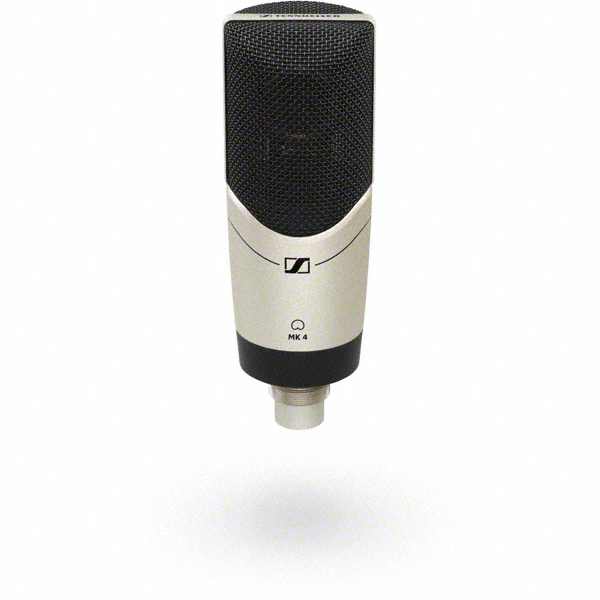 The Sennheiser MK4 is our top recommendation for any working voice artist. It’s a little known fact that Sennheiser actually own the Neumann company, and the MK4 diaphragm capsule was designed by the same team who built the Neumann U87. It’s a cardioid only mic with no pad, but sounds wonderful with both male and female voices. Compared to the other mics in this price category, this easily wins on performance and sound quality, whilst being robust and of a solid build. This is one of the best value mics in the range, is durable and reliable, and is the reason that we sell this mic in our store
#2 – Rode NT1/2 (~$249/£200) 
The Rode NT1 & NT2 are great first time voice mics. They give good resonance and similar frequency response to other voice mics. They are quiet and neutral sounding, and creates high-quality recordings with a wide dynamic range. It’s worth saying that there is a reason why this mic is not often used in professional studios, and that’s because the trained ear can ‘hear’ this mic – it sounds like a Rode NT – where other mics are more transparent. However, for newcomers to this industry, it’s a good, and relatively inexpensive option.
#3 – sE Electronics sE2200a II C ($299) 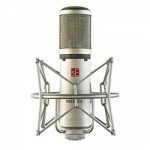
The sE2200a II C gives you a good quality and up-front sound. It is a versatile condenser mic which is ideal choice for first time voice actors. It’s highpass filter and 10dB pad give you sound-shaping options and low self-noise.
#4 – Lewitt LCT 440 Pure C (£245) 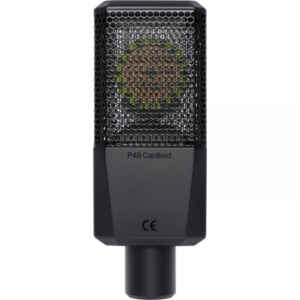
The LCT 440 Pure is a newer addition to the VO mic market. A large diaphragm cardioid condenser mic, the LC 440 Pure features a differnent design with its open front, magnetic pop-shield and included shock mount. In our own tests, we found it produces a clear and crisp sound through it’s 1″ condenser capsule and at it’s low cost, may be a good option.
#5 – Shure SM7B ($349) 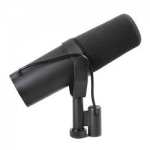
The SM7B is a cardioid dynamic microphone that is popular both in radio and sound studios. The basic sound of the SM7B is exceptionally clear, while still retaining presence and warmth. Its frequency response is very broad and can be switched if necessary. For increased presence, one only has to switch on the high-boost. The SM7B is ideal for use in a home studio. The integrated swing-mount makes precise and stable positioning possible. These mics are more often used in radio studios than voice studios.
#6 – Audio-Technica AT4033 ($399) 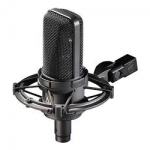
The Audio-Technica AT4033 offers good results in transient response and clean output signals. The AT4033 cardioid microphone has a 80Hz high-pass filter, and easily switches between flat frequency response and a low-end roll-off that diminishes ambient noise and popping with close vocals.
#8 – Rode NTK ($529) 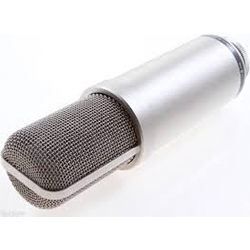
The Rode NTK is another good option for voiceover artists. It is ruggedly built, and gives you a warm and clear sound.
#9 – Audio Technica 4047 ($699) 
The Audio Technica is one of the range of voiceover mics that is designed for a range of uses. The transformer-coupled output and specially-tuned element provide sonic characteristics reminiscent of early F.E.T. studio microphone designs. It has low self-noise, wide dynamic range and high SPL capability. The body has a precision-machined, nickel-plated brass, acoustic element which provides enhanced stability and optimal sensitivity.
#10 – Miktek C7 ($899) 
The C7 is an ear-pleasing large-diaphragm FET condenser microphone — the sort of mic you can put up, turn up, and call it a day. Plus, thanks to the three selectable pickup patterns, the C7 is as versatile as it is sweet sounding. It features cardioid, omni, and bidirectional pickup patterns — each convenient. You’ll love being able to use the bidirectional pattern to capture two sources, making it great for interviews and general VO.
#11 – Blue Dragonfly 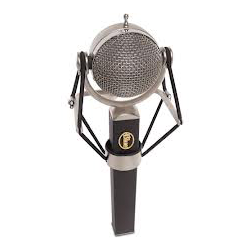
The Dragonfly is one of Blue’s most affordable mics. It provides a sweet sound like that of the vintage Neumann and AKG mics heard on thousands of recordings. It puts its own distinctive signature on the sound. The ability to position the capsule at so many angles relative to a sound source opens up a world of sonic opportunity for the VO artist.
#12 – Neuman TLM 103 ($1,099) 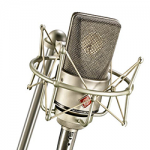
Although The TLM series was not designed for voice work (TLM actually stands for Transistorless Microphone), the TLM 103 is recommended by many voice actors. It functions with a transformerless circuit of the type that provides a low self-noise level and a wide dynamic range. The cardioid polar pattern capsule is particularly well-tuned for acoustic balance and good phase cancellation for sounds from the rear. One slight issue with this mic is that it has a lift in the high frequencies, and often makes higher, female voices sound a little sibilant.
#13 – AKG 414 ($1100)
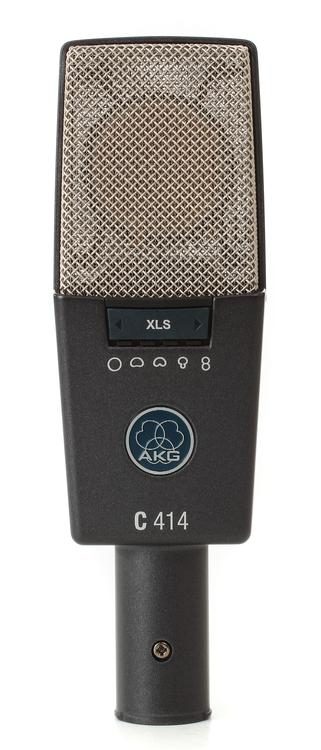 The AKG is a fantastic quality microphone and has a brilliant pickup range with a nice, flat frequency response. At the price it’s a mid-range microphone, but it’s a professional, robust mic. It has switchable polar patterns and a pad setting. This would definitely be a great choice for any working voice artist.
#14 -Microphone Blue Yeti Pro ($249.00)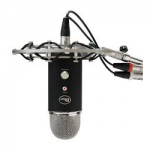
The Blue Yeti is a USB microphone that is ideal if you are just starting out on your voiceover career and budget minded. The Yeti come in 2 versions.. the Yeti and the Yeti Pro, the difference is that the Pro has a higher bit recording and the ability to use XLR. Of the USB mics we have tried (and although we don’t generally recommend them), this was one of the better ones.
#15 – Neumann U87 ($3180/£2500)
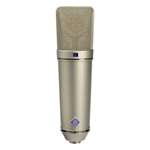
The U87 is the standard workhorse of the majority of professional recording studios in the world. It’s long had a reputation as one of the very best voice recording mics on the market and is reflected in it’s build quality, it’s performance and it’s price tag. While not cheap, this is an exceptional microphone with switchable polar patterns and a pad, a flat response and works well for both female and male voices. This mic is definitely recommended if you have money to burn, but the Sennheiser MK4 is a great alternative for a tenth of the price.
#16 – Sennheiser MKH 416 (Circa $700/£550)
The 416 is one of the most commonly found VO mics in the world. It’s a
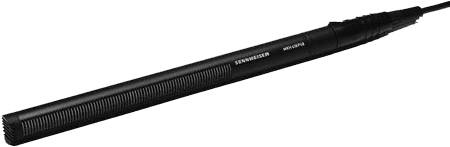 hypercardioid microphone (not a standard cardioid pattern mic) and because of this you have to be careful with being on axis whilst using it. For this reason, the 416 tends not to be used for character work, where the voice artists are more expressive and move more. The 416 was not originally designed for voice work, rather for capturing audio far away, hence it’s design; but a curious thing happens when you position yourself right in front of one instead of 8 feet away – you get an awesome, punchy commercial sound. This coupled with the fact that the 416 is extremely rugged and durable (you can throw it in a suitcase and travel with it without any worries, making it the go-to travel mic), and you have a winning mic used the world over and sworn as the best, by many VO’s. Most professional VO’s who have a 416 also have a good large diaphragm condender mic too, to cover all eventualities.
Summary of Voiceover Mics
When you are looking to choose the best microphone for voice acting work, the first place to start is to identify your budget. Then decide on the range of microphone you want. The ones we have listed here are well recognised in the industry for their quality. To find out more about microphones and how to setup your own studio take a look at the Home Recording Studio Course that we provide as part of our membership plan.
[V1.6 Updated on 6th Jan 2026]
Joe Wakeford says
Good post Hugh, we will give it a retweet for our VoicesUK users.
Abdullah Akbar says
Good job with this. Really helpful.
Lisa Greiter says
what are your thoughts on the CAD E100S?
Hugh Edwards says
Hi Lisa.
That mic is a supercardioid, not a cardioid mic. It does have the reputation of being everso slightly sibilant on female vocals especially, and it doesn’t have a strong bass proximity effect that you get with normal cardioids – but overall it’s a good mic. I think the issue with it is that for the price – there are better things on the market. So if you have one already, no problem, if you don’t yet have one – I’d advise you look elsewhere. 🙂
Irene says
Excellent advice on microphones to newcomers of the VO industry. Thank you very much!
Terry Charter says
Excellent post. I am also a newcomer to the business and presently in a VO program. I have been contemplating the AKG 414 but wondered if the AKG 214 may suit my needs better as I can’t imagine needing all those different polar patterns and pad settings. Also taking a hard look at the Rode NTK for a first. I hear good things everywhere about this mic. But truly, is there a sound quality difference between the AKG 414 and AKG 214? The AKG 214 costs about a third of the price of the 414. Your thoughts.
Scott Carmichael says
Where do Ribbon mics fall on this scale? I have heard they are very good.
Hugh Edwards says
Hi Scott.
Ribbon mic’s can sound nice, but they tend to be very fragile, need a large amount of preamp gain (up to 50db!) and are quite quirky to use. They also (by design) have a top-end rolloff which isn’t great for VO. We don’t recommend using Ribbon mics in place of large diaphragm condensers. But if you’re after some more info, check this out:
http://www.soundonsound.com/reviews/ribbon-microphones-test
I hope that helps!
Hugh.
Paula Leinweber says
Hi Hugh, thanks for this excellent article and the review of mics. What do you think of other Blue mics? When I was first trained a few years ago, my trainers recommended the Spark, which seemed to work well. I recently got back into vo and now am using the Bluebird. I haven’t had the opportunity to test other mics, but was curious what you thought of them for a female VO?
Hugh Edwards says
I have used the bluebird and it worked really well on female VO’s. I haven’t tried it on males. 🙂
Steve Harris says
Good blog. You may want to update the Rode NT1 picture though. It’s black in color now 🙂 I have the NT1 and bought it to replace the Focusrite/Scarlett CM25 units I have from buying a couple 2i2 studio kits. The CM25 is an OK starter mic, but I would not really recommend it overall due to being sort of noisy and pretty easy to distort. The Rode NT1 is far superior.
There is a caveat when upgrading your mic from one that is from the low end of the pack. All those little things one does wrong come to life when using a new mic that is much more sensitive. Better quality can lead to the need for better isolation of noise. It also revealed some flaws in my speech I was not aware of – things not getting picked up by the CM25. Nice to be able to hear that now and address it.
Also, if you are in the USA, you may be able to find great deals on the NT1 with the shock mount. I got one for $209. It was a real one and not a “counterfeit copy”. I made sure I bought it from a Rode recognized dealer. Check out the Rode website for their details and policy on their warranty. They will not cover mics bought via questionable shops. Sorry if this sounds a bit like a commercial. It is not supposed to. I’m just happy to have this new mic and how it can be had new for a good price.
Nadine Rees-Harris says
Hi Hugh
Enjoyed the webinar today, thank you. I am a novice as a VO artist but have recently become a volunteer presenter on our local radio station, hence it now seems the right time to do the VO stuff. I recently bought a Roland cube, cable and Shure SM58 microphone and am wondering if you think it would be ok for me to use this equipment to practice reading out loud with? Kind regards Nadine
Hugh Edwards says
Hi Nadine.
Yes of course. Pretty much anything is good enough for practicing! For pro recording though the SM58 is not really the right kind of mic. It’s a dynamic mic intended for use on stage and in situations where the input is very dynamic – and they don’t pick up the subtle nuances of the voice that VO requires. Something like the Sennheiser MK4 would be your best option. 🙂
Charles says
I have both the SM7B and the MK4, and of the two I prefer the MK4 going through a dbx 286 processor. The MK4/dbx gives you a lot more range to fool around with, where the SM7B requires your preamp to be maxed out. Also the SM7B is a lot larger and heavier, so if you are doing desktop VO with screen casting then you will find the MK4 to be a lot more forgiving. The SM7B might be fine for a broadcast hanging mic.
Casey Matthews says
Hello, Hugh. I am new to the voice over game and I have a deep baritone voice (male). I want a condenser mic that will suit my voice. Suggestions?
Thanks in advance.
Hugh Edwards says
Hi Casey – Yep[ – the Sennheiser MK4 – it’s the one! 🙂
Claire Wyatt says
Hi guys. Nice summary. I currently use the Rode NT1A as it works really well for my voice and is SOOOO quiet. I’m renovating and updating my home studio (https://clairewyattvoiceover.com/2016/11/18/brand-new-home-voiceover-studio/) at the moment and am considering a new mic too. I plan on doing a blind mic test with a few you’ve mentioned above to see if they do anything different/better for my voice.
I’ll keep looking around the blog to see if you have covered this – but I was wondering about the best mic to take when you have to travel. Any thoughts?
Hugh Edwards says
HI Claire. Most people use the MKH 416 to travel with as it’s robust and indestructible!
Claire says
Hiya, further to my comment above…
The only snag I’ve come across with the Nt1a is that it’s super sensitive. So, when I’m doing multiple radio commercials and I switch from a narrative style to a character voice (which has more dynamism, projection etc) the rode struggles. What would you suggest is the best mic for characters/drama/shouting etc?
Hugh Edwards says
HI Claire,
The Sennheiser MK4 would be our best choice. It’s incredibly versitile. The NT1A (to trained ears) does sound like a NT1A, and most studio professionals won’t use them.
That said it’s all about setting your levels properly in the first place. We have the How TO Record Yourself webinar for just that. 🙂
Hugh.
The cat guy says
I’m rather surprised that the Sennheiser 416 (an industry standard, if not the industry standard) didn’t make your list.
I personally use an AT 4040
Colin Watts says
Hello Hugh,
Thanks for a great round up of mics in the market.
I have two condensers from the Scottish based Red Audio (models RV8 and RV6), but I e never seen them reviewed.
Thexsorc looked good and I’m impressed with the sound of the RV8.
Any thoughts?
Thanks
Colin Watts
Bluebird Voice Overs
Hugh Edwards says
Hi Colin – try searching for individual reviews on Sound On Sound. 🙂
galebl says
Hi Hugh,
I have AKG C214 mic, which I didn’t see included in your list. Care to comment on this choice? I’d also love to get your thoughts on setting the gain control on the pre-amp. I was surprised at how high (about 3/4) I need to set it for an appropriate signal to noise ratio.
Dorothy Carbone says
Hi Hugh,
I have a ADK Hamburg MK8, which i don’t see on the list. Any thoughts? Thanking you in advance!
Christine says
Great site and really good post here, just wondered what your thoughts on the Sennheiser/Apogee partnered MK4 Digital version would be, i like the idea of being able to record on iPhone and iPad the only problem I can see is it doesn’t feature its own headphone output and apparently with iOS latency is quite bad especially when it comes to multi tracking layering other vocal tracks, instrument tracks while listening back to what you’re already put down. Not a problem with macOS but iOS is a problem. Alternative to the MK4 would maybe be the Apogee Mic+ (Plus) new 2017 version that has a built in headphone output.
Sarah McAvenna says
Hi Hugh,
Great post! I’ve been using the Rode NT1A for years which has worked brilliantly, but lately I’ve been having really awful sibilance issues. Having the mic off axis normally fixed the issue (as well as working at being careful with my S’s and T’s!) but now I just can’t seem to find that sweet spot. (I’m running the Rode through an Apogee Duet into Adobe Audition on the Macbook) It’s probably coming up to ten years that I’ve had the Rode for, what kind of lifespan do they have? I think it’s time to do an upgrade – which mic would you recommend for a female who has to watch their sibilance?!
Many thanks,
Sarah
John Mwalo says
Hi Hughe!
Thank for you creating this wonderful article.
That being said, I’ve heard lots of positive review about Harlan Hogan MXL microphone and I’m thus surprised that you’ve mentioned it anywhere in your article.
Armando Talavera says
Hello!
I am looking for a microphone that I can use on the go or while traveling. I am considering the Shure Motiv MV51. It can connect directly to my laptop and even my Android phone! Any feedback or recommendations?
LiliaS says
Hi Hugh,
what do you think of the Beyerdynamic MC 840, especially in comparison with the Neumann TLM 103? Any thoughts?
Thanks a lot!!
Hugh Edwards says
Hi,
We haven’t tested that I’m afraid – but you can see a review of it here: https://www.soundonsound.com/reviews/beyer-mc840
ravellivoice says
Any thoughts on the Focusrite Scarlett 2i2 Studio 2nd Gen mic that comes with the package? It’s a CM25 MkII Condenser Microphone.
Hugh Edwards says
It’s a good starting mic. 🙂
john says
I would love to win the blue microphone in black. But any colour would be great !
Question/ my son is 8 and just started his own you tube channel (doing commentary during geometry dash so far.. ) what out these would be good – or is there a headset one better for his age ? Thanks
Hugh Edwards says
Hi John,
Any would be good for him, but all are probably overkill! If you had one he should use that, if buying for him, a cheaper headset mic to start off with would be ok.
Karin Burcham says
Thanks for the info! Wish I had read it before I decided on the NT1 over the Sennheiser just for the bundled shock mount. 🙂
J Shackford says
Hugh, great article thank you for the help!
I’m struggling on deciding what mic I should use, and I’m hoping for your expertise here.
I have 2 use cases to solve for-
1. Voice over
2. Streaming live to Twitch
I’m a male with a midrange tone.
The room I use for streaming live is not optimized for sound.
Is there a specific mic you can suggest for this?
It seems like a condenser mic is better overall, but in a room without sound optimization would I be better off with a dynamic mic?
TonyMonaghan says
HI guys I have an Aston Spirit but its not mentioned in the list, I would like your opinion of it, I like it better than my Rode
Paul says
Hi Hugh!
Great article! However, it was written 4 years ago now. While the information is still very much relevant (and appreciated!) I wonder if the mics suggested have changed? ( I see you added the Lewitt LCT-440 Pure in 2017)
As this article was included, rather referenced, in my Beginers Drip, 😉 I’m sure many people reference it daily.
Thanks again Hugh!
Proud member of GFTB….
Paul
Crystal says
I agree with Paul. Well written article but an update is needed. I have a LeWitt and LCT 550
Cree says
Thoughts on the Sennheiser MKH416 as there are several VP professionals who swear by it as their “go to” mic. I have even heard the term industry standard used.
Alan August says
Good question (the one I was going to ask 🙂 )
I am currently using it in my closet booth. It made a huge improvement over LDC’s I tried — they picked up too much ambient noise. The 416 doesn’t pick up most of that. Down-side, you DO have to stay in that tight hypercardioid cone, but I’ve learned to do that. It’s considered a studio standard for commercial & promo VO studios around here (L.A.), maybe because of the clean, flat response.
I’d also be interested in Hugh’s thoughts, as the 416 is working great, now, but I’m always open to better options.
mike fraser says
I agree with Paul also. I am glad you have included Lewitt. I have a Lewitt LCT 440 Pure and my clients seem very happy with its results.
Mike Fraser
Another satisfied member of GFTB
Carolyn says
Is having a switchable polar pattern related to an increased price? I was interested in the Sennheiser MK4, but started thinking I may like to have switchable polar patterns. Is there something similarly priced that has a polar switch?
It seems having the option to go bi-directional may be good for recording vocals for music, or for interviews/podcasting. Or would it be preferable to have two mics in those scenarios?
Thanks
Kenneth Ritter says
A very good selection for sure. I want to get your feedback on the new HypeMic from Apogee. I just got it and the sound is far superior to other mics of it’s kind. It has it’s own compressor and audio interface with a mic jack. I have heard many mic comparisons on YouTube that makes this little mic stand up to the best of them.
Asmaa says
What about samson cou01?
Many poeple advise for it at tge begging
johnathan welsh says
What would be a good mic for my low bass voice?
Thankyou Johnathan Welsh
Kirstin_West says
And there I was thinking the Sennheiser MK4 was pricey. Oh well, I’ll start saving up for the more expensive ones and treat myself in a couple of years when I’m a VO master 🎙
Kirstin_West says
And there I was thinking the Sennheiser MK4 was pricey. Oh well, I’ll start saving up for the more expensive ones and treat myself in a couple of years when I’m a VO master 🎙
Leanne Harwood says
Hi Hugh,
I am building a home studio for voiceover work and already have a Blue Yeti USB microphone. I have the budget to upgrade a little but wondered if you thought the Rode NT1A, as it is offered as a package on a number of sites, is a better option than say the Shure MV7? I’m slightly sceptical about using my Yeti as I am a novice with mixing etc and have been advised to use an interface such as the Scarlett 2i2. Any advice is greatly appreciated!
Many thanks
Leanne
Abby says
Hello,
I am a female with a higher vocal range and looking for a mic that would work well for audiobook and commercial work. I am new to the business, but I have only used usb mics and am in desperate need of an upgrade. I am also a musician, and wondering if there was a mic that would encompass all of my recording needs? I have been looking at Rode NT1-A and NTK as well as the Sennheisser MK4 mic. Which of these (or other than these) do you think would best fit my needs?
Grant Hogarth says
I also have a mic I’d be interested in your take on: the MXL 770.
mark osborne says
Hello,
Is there a difference between the standard Sennheiser MK4 and the digital version please?
Thanks
MALCOLM MELLON says
How do you feel an AudioTechnica 2035 compares? Since I already have one… 🙂
Paul says
I’d like to see thoughts on the new Austrian Audio mics.
James says
Hello Hugh, I really enjoyed your review. I just wanted to ask you your opinion on the Apex line of condenser microphones, or if you are familiar with them, specifically the Apex 460 large diaphragm. I love it for my singing voice, but curious as to what you’d think of it for VO. Thanks in advance, Jc.
Anna Payton says
Great Article Hugh and thanks for everything you do on GFTB!
Would love an update on this blog though if you have the chance and any thoughts on newer mic releases since you first wrote it.
I have been using my Rode NT1-A since the start of the pandemic when I first bought a home kit (in order to continue working.) I recently built a new home studio (https://www.annalawrence.co.uk/british-female-voiceover-home-studio) and was thinking about finally upgrading my mic – can’t quite stretch to a Neumann but wondered if the MK4 is an upgrade or merely a side step from the Rode?
Thanks, Anna